A sustainable building system: dry construction

The building and architecture sectors are constantly evolving, not only in styles and design. An increasingly important role is being played by solutions with a green and sustainable footprint. This is one of the reasons why dry construction is finding a place today: an innovative system for the construction of buildings and their renovation. Let us analyse it together.
What is dry construction?
Dry construction is the alternative to the more classical wet concrete construction system. The main element of this technique is the absence of wetting materials.
- In classical construction systems, bricks are connected together with water, reinforced concrete, mortar or other adhesives.
- These are wet materials: they require time to dry out before work can continue.
- Dry construction involves the assembly of the components used with bolts, screws and mechanical seals that only need time to assemble.
- The dry technique applies to both the internal parts of a building and the external envelope.
- Metal and wood are the two main materials.
Dry construction actually has deep roots in history: it was already used centuries ago. This is attested by ancient timber constructions by means of interlocking systems.
There are therefore two key aspects.
- On the one hand, the elimination of water consumption for the construction of the structure.
- On the other, the importance of precision in the design of materials and their installation.
- The ultimate goal is to assemble without difficulty and on time.
How crucial the design is can be seen from the fact that mechanical joints and connections are needed at the points where components are assembled. The speed and safety of work on site also depends on this.
What materials are dry construction?

As mentioned above, wood and steel are the two typical materials of dry construction. Both are very strong and insulating.
- Wood is mainly used for prefabricated buildings.
- Steel is preferred for residential buildings and large industrial complexes.
An example that gives an idea of how dry construction works in practice comes from North America. Here, timber frames are the structure onto which the other elements are then applied by means of insulation material and wood or wood-derived panels.
- The frame functions as the load-bearing structure.
- Once the frame of the load-bearing structure has been fixed and established, the external cladding is anchored, mostly comprising lightened concrete slabs.
- At this point, the cladding such as plaster is applied to complete the facade of the building and insulation is provided to ensure the correct internal temperatures in summer and winter.
The work can be completed with additional cladding to give the entire building more character with expanded metal facades, completed with tailor-made parts ready to be integrated by them with mechanical joints, just like in dry construction.
Expanded metal for dry construction systems
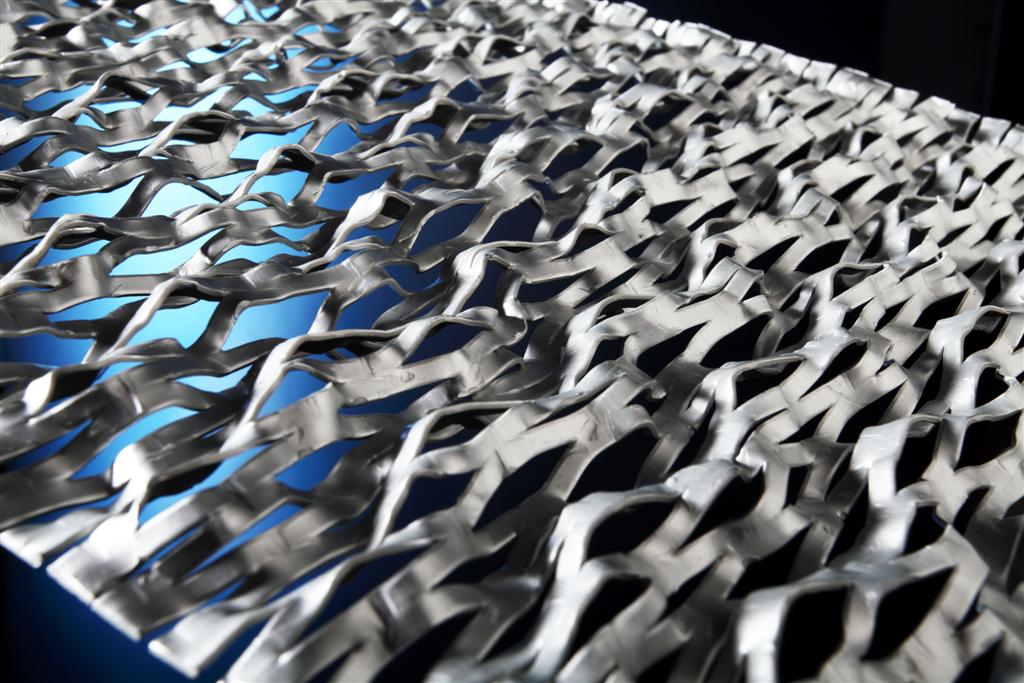
The expanded metal is reminiscent of a metal like steel and is very functional on an aesthetic level. The different widths of the open areas on the surface ensure a feeling of movement and the wavy lines make the final effect less static.
All this contributes to creating a play of light and shadow for those moving around the interior spaces. In fact, the expanded metal also functions as a sunshade: if desired, it can be combined with the parts of the building where the windows are positioned.
Sunlight filters through the openings, but not excessively. At the same time, the privacy of those living and moving about in the interior spaces is guaranteed.
Finally, expanded metal integrates perfectly with the concept of sustainability promoted by dry construction: its production does not generate waste and its parts can be easily recycled.
What are dry construction advantages?
One of the advantages of dry construction is undoubtedly the speed of the work. Without waiting for adhesives such as mortar to dry, time is optimised and the final cost of the work is low compared to the wet construction system.
Then there is the sense of lightness that the building conveys to the observer. However large the dimensions may be, the absence of the heavy concreting gives the structure a less impactful feel.
Regarding sustainability, dry construction as seen does not require the use of water, eliminating the risk of wasting this important natural source. It also makes maintenance and demolition of the building easier.
Materials are easily separable and for this reason become recyclable to find new life in other projects and reduce the impact on the environment.
